
Just the other day while I was driving home (or, I should say, my Tesla was driving me home), I said the following to the car: “Grok, I’ve got 20 minutes until my destination. Give me an overview of the fall of Constantinople that spans 20 minutes, in the form of a podcast.”
A couple seconds later, it began.
It may as well have been a produced podcast full of research that a team put together over weeks of work (maybe longer).
Historically, I would have had to discover such a podcast. Someone may have recommended it to me, or perhaps I searched for information on the subject and found it as a result.
But this is new. I commissioned it.
On a whim, I commissioned my own media content to consume, specific to my interests and time I wanted to allocate, and it was produced nearly instantly. Wild times.
The internet’s fundamental architecture
The breakthrough of the internet was the fact that it essentially took distribution costs down to zero.
Whether you were creating software or content, you could create it once and find a gigantic customer base or audience. This fundamental reality is the backbone for the sprawling SaaS industry, or for that matter, how Saturday Down South became a real thing.
Because of the breakdown of distribution constraints, it also led to a boom of content. Everyone became a content creator. Sure it started with blogs in the 2000s, and then YouTubers, but then of course everyone with a camera-enabled mobile device became a content creator.
Content became so abundant that the major bottleneck, as well as the innovation and value capture, sat at the discovery layer. Content abundance led to content value destruction. The value capture moved to discovery.
Social media companies designed algorithms to govern discovery.
Google had its search algorithms.
Algorithms helped users find what they were looking for out of the abundance of content that now existed.
And they monetized this chokepoint - at least in the case of Meta and Google - incredibly well.
The internet moved us from the distribution economy (where value was captured by entities that owned the distribution such as local newspapers, cable TV networks and so forth) to the attention economy. In the attention economy, it was the algorithms that captured the value because they masterfully owned attention.
But we’re entering another shift.
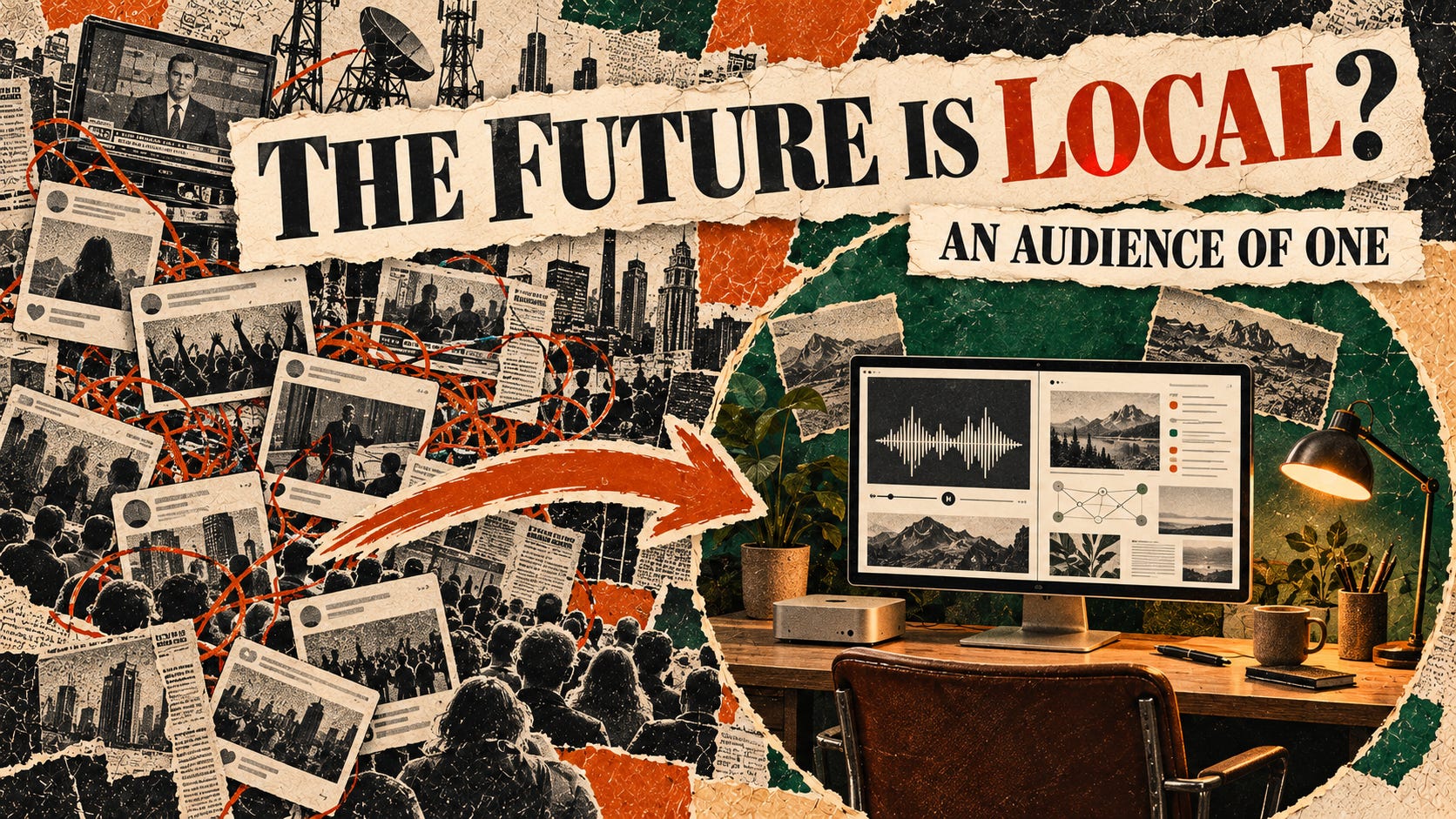
An audience of one
If the power of the internet was that you could create something once and get an audience of millions, the power of this next era (the agent era?) is that the constraints of creation are being totally removed to where it is now economically viable to have an audience of one.
The internet removed barriers to distribution. AI is removing barriers to create.
I mentioned the on-demand podcast example above. Here’s another example.
Recently I was trying to do some research on the history of the internet. I had my agent do some work and find some information for me. This was super helpful.
Then, I had the idea that it’d be nice to have an online tool that documented the research that was done, what was left to do, and maybe some key findings, etc.
So I had the agent build it. A few minutes later I had a nice SaaS-ish looking dashboard running locally. A command center, if you will, for this little project of mine.
It’s remarkable how simple and easy it is to spin up content and software for yourself to just use. Not market. Not find customers. Just use it. And then throw it away when you’re done.
There’s an old adage in startup-land that you should solve a problem for yourself, and then sell that solution to other companies who likely have similar problems. I’m not sure this is a viable statement anymore.
Today you can just solve that problem for yourself in seconds. And every other company that has that problem can also solve it in seconds on their own, at essentially no cost.
It’s not hard to be bearish on much of what one might consider the software industry or the world of SaaS.
From publishing to generating, from public to local
But getting back to the on-demand podcast, are we moving to a world where publishing is irrelevant? Where users can just generate what they want? Or even better, the agent can generate for you what it thinks you want?
Think of all the slop that the publishing world has put out in the last ten years as it chased the page view economy. I don’t blame this world, I was a part of it.
The public internet is under pressure right now. The web and social world are being flooded with fake material, inaccurate information and more.
Cyberattacks are on the rise.
As the public internet turns into a “risky” wasteland, users are going to increasingly move to secure, walled gardens. And to local.
What do we mean by local?
Well, we’ve explained two local examples so far. Local generation of content. Local generation of software. Each for an audience of one.
Is it truly local if I’m using LLMs from the outside? Probably not, but do future Mac minis come preloaded with ultra capable AI models that can be leveraged without even an internet connection?
Is the future offline? What about getting the latest information, even things like who won the Magic game last night?
There are still more questions than answers, but I think the clear answer is things are changing rapidly.
…
It doesn’t escape me that I’m literally writing about the idea that we don’t need to write anymore. And that things can just be generated.
So why am I writing this? It’s a good question.
Maybe the act of writing is something I enjoy. A process for working through thinking, rather than letting my brain rot while having the AI tell me what to think about things.
Again, more questions than answers right now.