
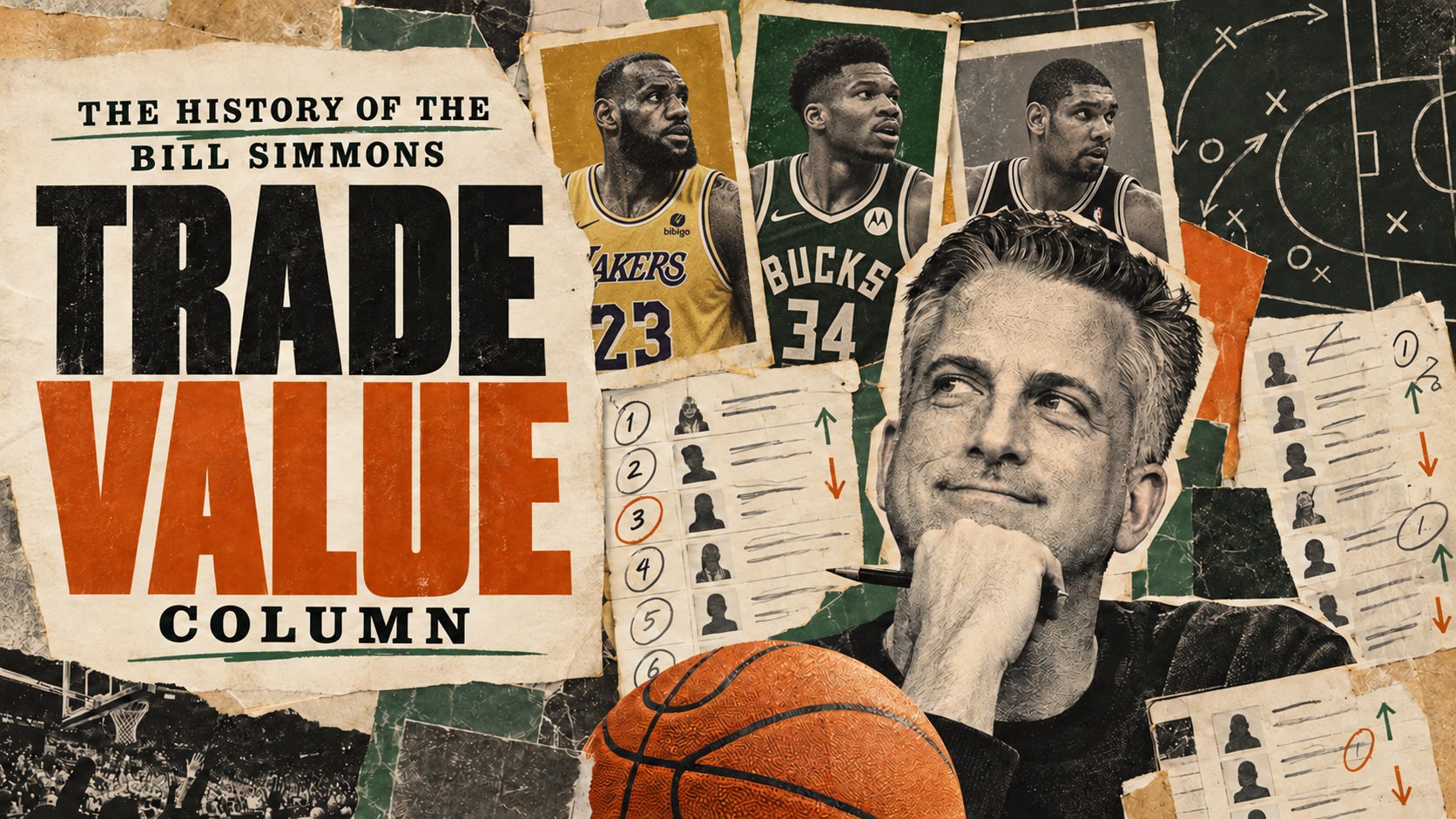
I’ve been doing research on the history of the sports web (defined as users facing sports content on websites) during the era of 1995-2025. Of course, Bill Simmons is a prominent part of this. He might be the most important single individual of this era. And, his annual trade value column (not a column anymore) might be the pinnacle contribution from Simmons to the sports web.
Let’s discuss…
The Beginning & The Evolution
The first trade value column came in 2001, and even the first edition really had all the markings of a Simmons classic.
The pop culture references were there: “the NBA’s decision to expand to Canada was right up there with New Coke and Rocky V”
Conspiracy theories were present: “because David Stern wears a Knicks jersey to bed every night”
Joe House was mentioned! “Now we’re going to play a game that my buddy Joe House and I argue about from time to time — “Who has the highest trade value in the league?””
And of course, we get some early glimpses of Simmons’ Tim Duncan love. Duncan was the no. 1 asset on the first trade value column. Here’s what he had to say: “I spent about 20 minutes debating “Duncan vs. Garnett” before tabbing Duncan, if only because a) his teams seem to win big games and b) if you look at Duncan’s supporting cast, it isn’t significantly better than Garnett’s supporting cast, yet San Antonio is a bonafide title contender and Minnesota is a second-tier playoff team. If I had to pick any team to win the title right now, I’d pick San Antonio… only because of Duncan. So he gets the nod. I will now light myself on fire.”
The first version had a long intro (yes, Bill had no regard for word counts even in the early days) and ranked the top 40 players.
The rules would stay the same, and the format mostly stayed the same. Though it would evolve slightly. The list expanded to 50 players in 2007, then back down to 40 in 2009, back up to 50 in 2011 and in 2012 we started getting the column broken into multiple parts. There were some years it didn’t happen. When it rebooted at the Ringer, we got a list of 55 people, then in 2019 it moved away from a column into more a interactive page with lots of visual design and stats. Throughout the various changes, it remained very “Bill Simmons.”
Trade Value No. 1 Rankings
So, who has been at the top of the BIll Simmons trade value list over the years? I’m glad you asked, because I went through each one and documented it:
2001: Tim Duncan
2002: Shaquille O’Neal
2003: Tim Duncan
2004: Lebron James
2005: Tim Duncan
2006: Dwayne Wade
2007: Lebron James
no column in 2008
2009: Lebron James
2010: Lebron James
2011: Lebron James
2012: Lebron James
2013: Lebron James
no column in 2014
2015: Anthony Davis
no column in 2016
no column in 2017
2018: Giannis Antetokounmpo
2019: Giannis Antetokounmpo
no column in 2020
2022: Giannis Antetokounmpo
2023: Nikola Jokic
2024: Nikola Jokic
2025: Victor Wembanyama
2026: Victor Wembanyama
If we tally it up, here are the players and the number of times they were ranked no. 1:
Lebron James: 7
Tim Duncan: 3
Giannis Antetokounmpo: 3
Victor Wembanyama: 2
Anthony Davis: 1
Dwayne Wade: 1
Shaquille O’Neal: 1
The Running Lebron Commentary
One of my favorite things as I went back through all the iterations and editions of the trade value column was to read the annual commentary about Lebron James straight from the fingers of Bill Simmons.
If the trade value column is the pinnacle of the Bill Simmons written content experience, the 2013 edition’s no. 1 ranking of Lebron James is the pinnacle of the trade value experience, bringing to bear the full toolkit of Bill Simmons. More on that in a moment.
2004:
Lebron bursts into the league as a rookie and is everything anyone thought he might be. He turned 19 during his rookie season. Of course he topped the trade value list which intends to value everything from talent, health, age and contract.
Come on … you were expecting someone else?
2005:
For some reason, Simmons dropped Lebron to no. 4! It might be the most egregious ranking in the history of the Simmons trade value column. And it’s as if Simmons knew it. He dedicated a couple full paragraphs to explain the decision of putting him behind 3. Dwayne Wade 2. Amare Stoudemire (lol) and 1. Tim Duncan:
Should be the No. 1 guy on this list. But LeBron’s situation in Cleveland reminds me of one of those SNL situations with Will Ferrell, Eddie Murphy or Chevy Chase – yeah, they were the undisputed star of the show, and yeah, they had some great moments. But at some point, they outgrew the show and it became inevitable that they would move to Hollywood and start making big-money movies.
In LeBron’s case, he’s the best young player in the history of the league – both statistically and aesthetically – as well as someone destined to become the biggest superstar in any professional sport (maybe ever). He’s going to accomplish things that we didn’t think were possible anymore – averaging a triple double for an entire season, leading the league in scoring and assists, stuff like that. Eventually, he’s going to start “making big-money movies” (translation: play for one of the league’s marquee franchises, either the Knicks or the Lakers), if only because it’s in the best financial interest of everyone involved (and I mean, everyone). That’s his destiny, and that’s how this will play out. There’s no other way. If the Cavs were smart, they would trade him now. But this is the same franchise thatgainfully employed Jim Paxson. So anything’s possible.
2006:
If the 2005 edition included a long justification of not putting Lebron, 2006 was even longer. At least he was no. 2, but still it was absolutely absurd to put him behind 1. Dwayne Wade:
I know, I know — under normal circumstances, he’d be No. 1. But these are the facts …
A. I keep writing about this, and everyone in Cleveland keeps sending me hate mail, and I don’t really know what else to tell you … but people around the league swear that there’s a clause in LeBron’s Nike contract (already worth $100 million) that doubles the money if he plays for an NBA team based in New York, Chicago or Los Angeles AND that some of his other endorsement deals have the same clause. Don’t shoot me, I’m just the messenger.
B. We know that LeBron and his peeps are already positioning himself as a multimedia presence, someone who could potentially emulate Magic and P. Diddy and own record companies, movie theaters, clothing lines and everything of that ilk. You need to live in a big city to pull this off — either New York or L.A.C. The Cavs blew their cap space last summer (more than $160 million spent on Zydrunas Ilgauskas, Damon Jones and Hughes) and have no real way to improve. If you remember, by the end of the Detroit series, poor LeBron was a one-man show. Do you think he wants to spend the next eight to 10 years carrying a mediocre supporting cast?
D. LeBron becomes an unrestricted free agent in the summer of 2008. He could sign an extension with the Cavs this summer, but there’s really no reason to do so. Thinking logically, he could break any bone or blow out any ligament over the next 24 months and STILL get offered a max contract by every team with cap space. So why not see how this season unfolds and keep his options open? No injury short of paralysis could hurt his value over the next two years.
E. From the NBA’s standpoint, nothing would generate more interest in the 2006-07 season than the running subplot, “Is LeBron staying or going?”
F. The first day that teams could offer max extensions to rookies from the 2003 draft class: July 1, 2006. We know that Denver offered one to Carmelo (quickly accepted), Miami offered one to Wade (quickly accepted), and Cleveland offered one to LeBron (NOT accepted — plus, neither LeBron nor his agent has commented publicly and it has been six days and counting). The silence has been deafening. Repeat: Deafening. In fact, it’s developing into the biggest sports story of the summer and nobody seems to give a crap. But they will. Just wait.
G. Everyone in Cleveland is having a collective heart attack. And with reason. If LeBron ends up fleeing the Cavs, that would be the biggest non-injury/non-death blow to a professional team in sports history. Unless they were able to sign-and-trade him for a mother lode of players and picks (like the Oilers did with Gretzky), basketball would die in Cleveland and the team would have to move. Imagine living in Cleveland, watching LeBron pass through town like a comet — the next Ali/Tiger/Pele/MJ — then he spends the heart of his career playing in another city? How do you bounce back from that? The answer: You don’t.
H. There are dozens of reasons — literally — why Isiah Thomas is one of the worst executives in sports history. But his failure to create cap space for the summer of 2008 just in case Facts A-thru-F played out remains his all-time dumbest move. Yes, even dumber than the Curry trade.(Note: If Bron-Bron re-signs with Cleveland this month, disregard everything in the previous few paragraphs and move him to No. 1 on this list. You never know. And just for the record, I hope he stays in Cleveland because LeBron splitting town would be one of the cruelest sports stories of all-time, even if it was overwhelmingly predictable from day one, and no fan base deserves to get kicked in the collective groin to that degree. Well, unless he goes to the Clippers. Then I would wet myself. Repeatedly.)
2007:
Starting in 2007, Simmons stopped the mental gymnastics and put Lebron no. 1 on the trade value list every edition through 2013:
You know somebody is great when his ceiling as a superstar — which we raised this season because LeBron finally started treating every regular-season game like a playoff game on both ends of the floor — manages to trump everything from the previous three paragraphs. Amazing.
One more thing: In my humble opinion, 2007 LeBron and 2007 Howard are more untradeable than anyone in the seven-year history of this “Trade Value” column, even surpassing (gulp) 2001 Shaq and 2003 Duncan. Yup, I think we’re in pretty good shape with the National Basketball Association right now.
2009:
In 2009, Simmons is completely won over, gushing about Lebron:
Last February, I wrote that he didn’t have a ceiling. This year? I figured out his ceiling. At least for right now. At age 24, he’s a cross between ABA Dr. J (unstoppable in the open court, breathtaking in traffic, has the rare ability to galvanize teammates and crowds with one “Wow” play, even handles himself as well off the court) and 1992 Scottie Pippen (the freaky athletic ability on both ends, especially when he’s cutting pass lines or flying in from the weak side for a block), with a little MJ (his overcompetitiveness and sense of The Moment), Magic (the unselfishness, which isn’t where I thought it would be back in 2003, but at least it’s in there a little) and Bo Jackson (how he can occasionally just overpower the other team in a way that doesn’t seem human) mixed in … only if all of that Molotov Superstar Cocktail was mixed together in Karl Malone’s body. This is crazy. This is insane. This is unlike anything we’ve ever seen. And to think, LeBron doesn’t even have a reliable 20-footer or a post-up game yet. See, this is only going to get better. And it’s already historic.
As a Celtics fan, I shudder for the future. As an NBA fan, I am pinching myself.
2010:
The 2010 edition brings some Lebron commentary that is perhaps the most Simmons-ish up to this time in history. We get introduced to a “Tornado Test.” It includes personal anecdotes, story telling and the coining of a term. It’s perfect:
LeBron threw a party at Ghostbar in the W Hotel on Saturday night. The club stretched way back, farther than most people realized, so there was a second bar in the far back that wasn’t too crowded. Next to the bar was a roped-off corner area of sofas and tables with bouncers and bottles ready to go. LeBron’s section. Definitely. My friends and I carved out territory at the back bar partly for the extra room, partly for that moment when LeBron’s crew arrived and it turned into a madhouse. Once upon a time, when Jordan was still the king, I described his entrance at an All-Star Weekend party like a gust of wind. You’d be hanging out and then … whoosh! Just a tornado of people with Jordan at the epicenter. I wanted to see whether LeBron, at this point in his life, would provide the same thing.
An hour passed. We forgot about him. We were drinking and making fun of each other. And then, suddenly … whoooooooooooooooooooooooooooooosh!
The number of people in the room quadrupled. We were hanging onto the bar counter like people holding onto trees and walls in a tidal wave. The people kept coming and coming. You couldn’t hear anything. Everyone was dancing. In the middle of the tornado, we could see LeBron, his head bobbing up and down to the music, the once and future King. You could say he passed the Tornado Test.
2011:
Short and sweet this year:
Underrated. Even as we’re constantly overrating him. And I swear, that made sense when I wrote it.
2012:
Here we get another vintage Simmons performance. An indepth combination of statistical analysis paired with historical comps. Plus we get the tried-and-true letter organization of three points. Excellent stuff all around:
Stick a fork in the 2012 MVP race. A 28-8-7 with 55/39/79 splits, world-class defense and a staggering 33 PER? Child, please. We spend so much time picking the Regular-Season King apart that it’s easy to lose sight of the bigger picture — only Bird, Magic, Kareem, Russell and Wilt ever won three MVP awards in four years. I find it interesting that …
A. If you’re starting a “Which Players Peaked With the Best Four-Year Runs?” discussion, you’d have to include 1984-87 Bird (3 MVPs, 2 titles); 1987-90 Magic (3 MVPs, 2 titles); 1990-93 Jordan (2 MVPs, 3 titles);17 1961-64 Russell (3 straight MVPs, 4 titles); 1965-1968 Wilt (3 straight MVPs, 1 title); and 1971-74 Kareem (3 MVPs, 1 title).
B. LeBron would have a chance for four straight MVPs if The Decision didn’t unleash last spring’s “I just don’t feel right about voting for him, I’m picking Derrick Rose” backlash that eventually corrupted too many voters and media people. Including me. Nobody has ever won four straight MVP awards. 2009-12 LeBron and 1990-93 Jordan probably came the closest. And Russell was the only one who won four MVPs in five years.
C. You may have noticed that everyone else on that “three MVPs in four years” list won at least one title. So if Miami blows the title this spring, LeBron really will be making history. No pressure or anything.
2013:
And we reach 2013. The pinnacle achievement of the Bill Simmons trade value franchise, in my opinion. The no. 1 ranked Lebron James gets some commentary alongside his ranking, but not just any commentary. He gets a full blown mailbag entry. Yes, Simmons turns the no. 1 ranking on the 2013 trade value column into a Lebron James centric mailbag. Or, a mini-LeBronbag as he says. I can’t imagine anything else being Bill Simmons written content apex mountain than this:
Let’s break into a mini-LeBronbag …
Q: Last year you memorably wrote that the NBA MVP trophy should vary in size based on the level of performance by that year’s MVP. So wouldn’t this season qualify LeBron for a 40-pounder? Especially considering what he has done for his fourth trophy compared to what he did for the first 3. After this season we are firmly in the LeBron James era.
—Steven Feister, Los AngelesSG: I thought it was a 40-pounder. He’s the league’s best offensive player and one of its best defensive players, someone who can guard everyone from Nate Robinson to Zach Randolph. He’s the alpha dog on one of the best regular-season teams ever, for an offense that was carefully constructed to take advantage of HIS talents. He single-handedly kept that historic 27-game winning streak going four or five times. He never took a night off. He had the best and most efficient all-around year of his career. He’s astoundingly durable. He’s the best player in 20 years. There’s nobody like him. He’s only the second guy to win four MVP awards in five years, along with Bill Russell. He should have won unanimously. He’s headed for his second ring. I don’t know what’s left. If LeBron’s career was a movie, we’d be living this scene … and I think the 2013 Finals would probably be the tiger.
Q: I propose renaming the Coach of the Year award for Mike D’Antoni. Why can’t we call it the “Not Mike D’Antoni” award? What better way to honor someone who somehow made a team with four future Hall of Famers unwatchable all year. Here’s how it works: This year’s Not Mike D’Antoni Award goes to Erik Spoelstra. He brilliantly built a unique offense around his best player and took his team to near historic levels. In other words, he’s not Mike D’Antoni.
—Jason, VirginiaSG: (Standing and applauding.)
Q: Let’s say LeBron switched spots with the best player on every other playoff team and we could play out the playoffs 16 different times. How many titles would LeBron win out of a possible 16 (including him just staying with Miami)?
—Tommy, El Paso, TXSG: Assuming we still have the same injuries (including Westbrook’s knee) every time in this ridiculous hypothetical scenario, I’m giving LeBron the 2013 title in Miami, New York, Indiana, San Antonio, Memphis, Denver, Golden State, Chicago and the Clippers. Oh, and you could have talked me into Milwaukee after enough drinks.
Q: Neo coming back to life in The Matrix and becoming The One is exactly what happened to LeBron game six in Boston last year. I guess we’re in Matrix Reloaded now where LeBron can win as many games as he wants in a row like Neo defeating a million Agent Smiths. I guess next year LeBron will be reunited with the Source or something.
—Marc Feffer, New YorkSG: I’ve never seen The Matrix … but sure! Sounds good.
Q: LeBron now looks like the only Queen on an NBA chessboard (and I mean that as a true compliment). He now understands it all. Angles, spacing, etc. … He is blessed with such physical skills that he can impose his will, at will, regardless of the other nine paid professionals on the court. When he decides to take over a game it is unlike anything I have ever witnessed. He bends the entire game, all action on the court, towards him, at both ends. I have never seen anything like it.
—Matt Robinson, Edmonton, AlbertaSG: It’s the perfect analogy. Matt Robinson couldn’t be more correct … LeBron is the queen on the chessboard. You could only say that about two NBA players: him and Magic. Nice company. He’s one of the 10 best players of all time … and climbing.
Q: Loved the trade value trilogy. I’m really glad you stretched it out to three parts. Oh wait, you haven’t written it yet and probably never will; you suck.
—Will S., ChicagoSG: Yup, this was your Trade Value trilogy.
2015:
We close out the Lebron commentary via the trade value columns with a statistical-heavy analysis of peak Lebron. It’s really good stuff. And of course, sitting here over ten years later, Lebron is still playing basketball. Oh, Simmons ranked Lebron no. 2 this year, behind Anthony Davis. Which is pretty funny, but maybe understandable at the time?
Let’s have one last round of applause for LeBron’s incredible eight-year run atop the Trade Value list.
What happens next? The 30-year-old budding mogul has already logged more than 42,000 career minutes and played more than 1,050 games (including playoffs). You know what that really means? Apex LeBron is gone. Here, look.
Seasons 1 through 4 (316 games)
41.3 mpg, 26.7 ppg, 6.7 rpg, 6.4 apg, 46-33-73%, 8.3 FTA, 3.3 TO, 24.2 PER, .181 WS/48Seasons 5 through 11 (526 games)
38.4 mpg, 28.0 ppg, 7.6 rpg, 7.1 apg, 52-35-76%, 8.7 FTA, 3.3 TO, 30.1 PER, .283 WS/48Playoff Career (158 games)
42.5 mpg, 28.0 ppg, 8.4 rpg, 6.4 apg, 48-33-76%, 9.7 FTA, 3.4 TO, 27.7 PER, .242 WS/48Season 12 (57 games)
36.2 mpg, 26.0 ppg, 5.7 rpg, 7.4 apg, 49-35-72%, 8.0 FTA, 4.2 TO, 26.2 PER, .196 WS/48.The good news: He’s still 85-90 percent as good as that seven-year apex, keeping LeBron’s “best player in the league” ceiling the highest of anyone. I just don’t know where this goes. How long can LeBron stay great or even close to great?
In NBA history, only 35 guys have played more than 875 games and logged more than 34,000 minutes while averaging 35 minutes per game in their first 13 seasons. (Even though LeBron did it in 12, I added an extra year for everyone else because, you know, LeBron is superhuman.) Only 22 guys played more than 120 playoff games in their first 13 seasons while logging more than 5,000 playoff minutes and averaging 35 minutes per game. And only 12 guys cracked both lists: LeBron, Jordan, Wilt, Duncan, Russell, West, Bird, Pippen, Kobe, Hakeem, Malone and Havlicek.
Wait a second … that’s a great list! We just ripped off 12 of the 25 best players ever. Just so I can sleep tonight, let’s include Dirk, Magic, Shaq, and Kareem as well, giving us 16 guys who passed 40,000 minutes (regular season and playoffs combined) in 13 years or less. That’s an insane day-to-day burden for anyone’s body, no matter how great you are. You’re talking about three-plus presidential terms of grinding out 80-100 games in eight to nine months (and carrying a huge burden, no less). After passing that benchmark, Kobe (four more first-team All-NBAs and a Finals MVP), Havlicek (second-team All-NBA and a ’76 Finals win), Duncan (two more Finals), Malone (1999’s MVP and two top-15 years after that), Shaq (first-team All-NBA and one more title in his 14th season), Dirk (third-team All-NBA in 2012, relevant even now) and Kareem (who doesn’t count because he was an alien) thrived for at least a little while. Nobody else did.
But 50,000 combined minutes? That’s the danger number. Kareem passed 50,000 during the 1983-84 season, won the 1985 Finals MVP and remained relevant through ’88 (back-to-back titles), but again, he wasn’t human. Duncan passed that mark last season, then helped San Antonio win 2014’s title. (Of course, he’s also an alien.) No non-center remained a star after 50,000 minutes except for Kobe; he passed that mark during the 2012 playoffs, then thrived offensively the following season right until his Achilles snapped in half. These things don’t end well. I think Kobe knew it too. That last season, he could feel his body breaking down and turned into Quint from Jaws: He started revving his boat’s engine until smoke began pouring out. He knew. He had to know.
Here’s the point: History says LeBron has two elite seasons left after this one, maybe three. That’s it. And you wondered why he didn’t want to wait around for Andrew Wiggins.
On the other hand … LeBron is only 30 years old. That’s the same age as Scarlett Johansson, Matt Cain, Mandy Moore, Adam Morrison, Katy Perry, Rick Nash and Purple Rain. When Bird turned 30, he was the reigning back-to-back-to-back MVP. When Jordan turned 30, he was four months away from finishing off his first three-peat. When Magic turned 30, he was getting ready for his third MVP season in four years. Doesn’t it seem insane to think that LeBron is passing his prime at THIRTY? Then again, only Kobe crossed 40,000 minutes before turning 31, but it happened over 13 years (not 12 like LeBron), and he didn’t take nearly the same physical night-to-night pounding. So who the heck knows?
Either LeBron will make history, or history will catch up to him. It’s one or the other. Just know that he’s no longer our most untradable player. For the first time, you can see a finish line for LeBron James. Unlike …
The Future: Substack?
What’s the future of the trade value column?
Like Simmons himself, you can argue that the trade value column has been quite adaptable to the various formats of online consumption over the years.
Of course we had many years of the lengthy written content format. To my surprise, he actually has been doing an audio / podcast version of this since 2007 as well. In the intro of the podcast, Simmons and Joe House talk about how this is the 1st edition of the trade value “argument” via podcast, but it’s the 7th year of the trade value column produced for consumption online (written). But of course, like most of Simmons content franchise that are born out of real life fandom, he notes that it’s probably the 20th year that he and House have argued about the most valuable trade value asset in the NBA. Good stuff.
As The Ringer took shape, Simmons and his team set out to make a killer website destination. And I’d say they did. Part of the web experience of The Ringer are the very cool interactive long-form page designs for various lists and rankings that they came out with. For example:
These are very cool online destinations. As somebody who loves interesting combinations of product and content, The Ringer is one of the best.
And so it made sense for The Ringer to publish the annual Trade Value list in these formats. And it looks like an updated trade value list is coming off of the new Top 100 list linked above.
But as The Ringer is clearly de-emphasizes The Ringer dot com, it seems to make total sense to move the trade value column to a Bill Simmons substack. If I were making the decisions, I’d launch the Substack with the relase of the next trade value column. Zach Lowe similarly just launched his updated ‘League Pass Rankings’ as part of his new Substack. It just feels too obvious of a play for Simmons, and if Simmons actually felt like writing, his Substack would be extremely successful.
Is It The Top Simmons Franchise?
I think it’s a clear yes.
Simmons had some great one-off columns, especially from the early years (Is Clemens the Antichrist?, The Consequences of Caring, One Final Toss for the Dooze).
There were great mini-franchises like the Bill Simmons-Malcolm Gladwell email exchanges. The creation of the “Woods Number” in Simmons-Gladwell V is one of the funniest things I’ve read in a column.
There are a number of podcast specific franchises like the annual NBA over/unders.
The first Heat “Rewatchable” discussion spawned a whole new podcast feed called the Rewatchables.”
But the trade value franchise is a clear no. 1. It’s been going for 25 years. It’s spawned multiple formats, written, audio and video. Sports fans during the last 25 years that consume online content know trade value = Bill Simmons.
I think it’s safe to say - to use a Simmonsism - the trade value franchise has the belt.
You can view the pre-Ringer archives of Simmons’ Trade Value column at https://grantland.com/nba-trade-value/