
In the recent post, The future is local?, I noted that the audience of one is a viable consideration in today’s world of endless creation. Do you know what’s better than an audience of one? An audience of your best buds.
I’ve made the case numerous times that the group text chain remains the most important “online community.” It’s fun. It’s useful. There’s no commercial intent lurking adjacent to it. It’s a digital representation of real friendship and relationship. It’s perfect.
When watching live sports, how do we react when a major moment happens in a game? Do we go on Twitter/X and make a punchy comment? I usually chime in on a group text chain with friends going back decades. Did you just see what Steph did? Can you believe how bad the Gators are?
I believe in the “group text test.” Did something just happen that was big enough to warrant a group text?
Also in the above mentioned article is the idea that the mass market internet has likely peaked. Whether it’s become the endless security issues and hacks or the endless slop that’s being created online, smaller and more private networks are increasingly important.
And the fantasy sports league is basically the group text chain of online sports media.
The Two Web Theory
The web is splitting in two. I’m not the first to come up with this. A few have been writing about this (here and here, for example). The idea is simple. There’s one internet for humans and one for agents/AI. The AI will consume the content, the data and the information. And the humans will do things that are fun, experiential, and interesting.
The gap will widen between information and entertainment.
Discovery of information will increasingly be owned by the machines and humans will use the web to not go read about something, but to go do something fun.
If we consider the world of sports media, this means users will be less likely to go to a website to read some analysis about their favorite team than they will be to go play a game, watch their favorite personality talk about sports or participate in a community of fellow sports fans.
Fantasy sports remains an ideal area of focus of the human web. Fantasy sports check many boxes of the human web: games, community, entertainment, fun. And it even bridges the offline and online worlds. In a sense, it’s the most defensible area of digital sports media in this critical moment of change.
I recently put together a chart in an attempt to think through the various forms of online content and the economic models pertaining to each:
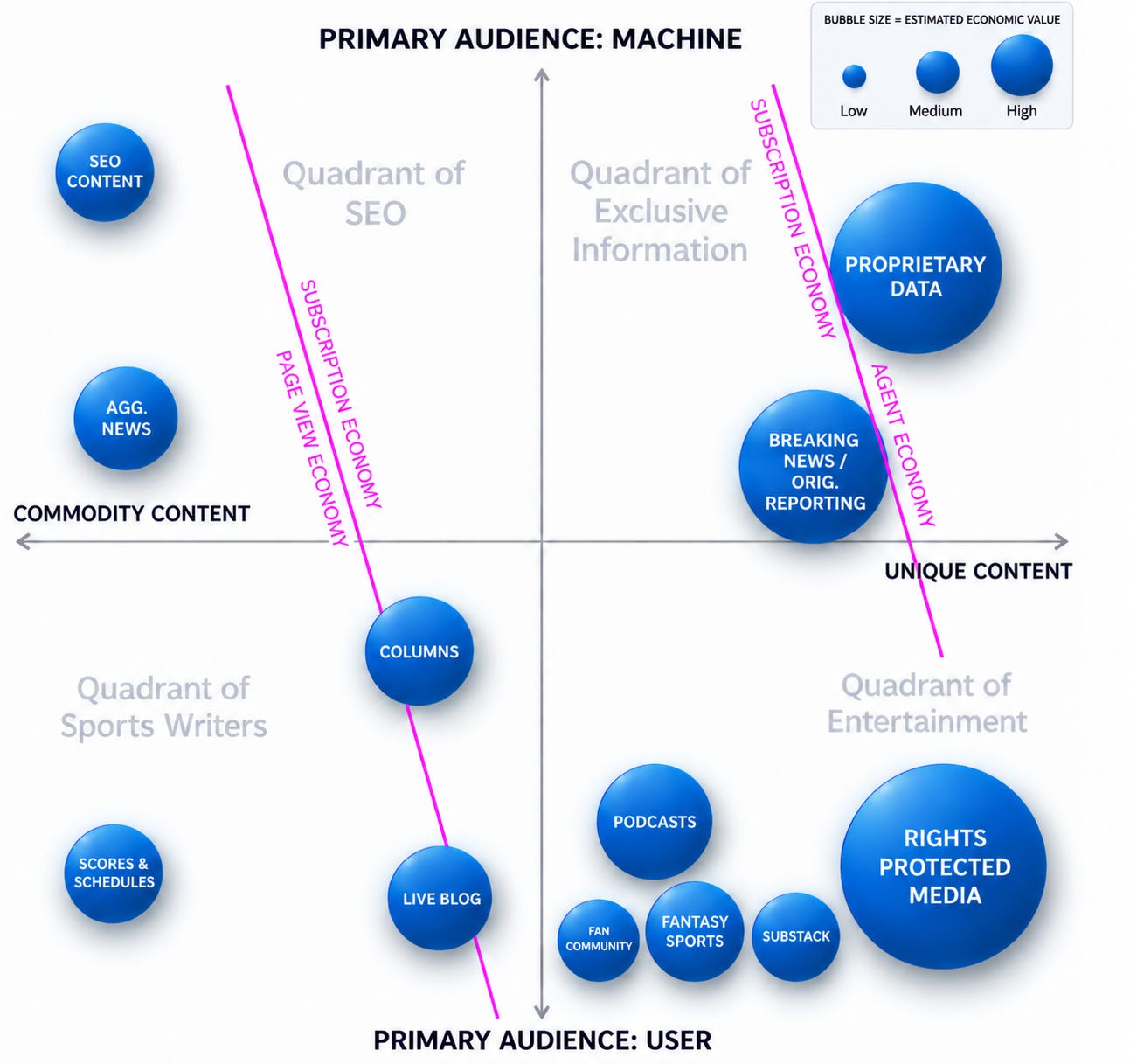
The page view economy is collapsing as publishers buckle under declining traffic. Most publishers cannot succeed in the subscription economy either. Their content isn’t good enough, offerings not robust enough and they don’t have a community that users feel compelled to join. But fantasy sports remain incredibly viable and in my opinion, have been consistently underrated.
Opportunities
Underdog Sports remains one of my most disappointing companies in recent years. They had an incredible product laser focused on games for sports fans.
But they inevitably chased the sports betting ecosystem (I understand. The venture backed company had to chase the higher returns). I believe that Underdog could have been the pinnacle sports games and community app. But now will likely just be an afterthought as a result of its constant pivoting into the latest betting-related ecosystem.
If I were an established fantasy sports provider, I would be doubling down on fantasy sports. And not daily fantasy sports where it’s more of a betting product than a fantasy product. Fantasy products are fun and involve fan community. This is the sweet spot. This remains viable no matter what direction the web and social media take as technology and media consumption rapidly change.
The internet rewarded distribution. Sports media companies built substantial businesses aggregating attention and monetizing it. Search and social worked hand-in-hand with this.
AI is making information and content endlessly abundant. The attention economy is crumbling.
The digital attention economy is no longer aligned with how sports fandom works. Sports fans are committed, loyal, persistent. These things have value. Digital attention is fragmented, fleeting and irrelevant. These things don’t have value.
Fantasy sports bring habit, enjoyment and cross over from the digital world into the real world. How often do you see fun social posts about the “punishment” that an individual had to do as a result of coming in last in a fantasy league? This is fun. This is community.
Fantasy sports has the opportunity to become more of a “sports consumer operating system.” There is tremendous value to be mined. Can fantasy communities extend beyond a single season, beyond the intiial draft spike of enthusiasm? Could more of the online sports fandom experience route through the lens of a fantasy sports league or contest?
Cracking this nut as a product would unlock tremendous enterprise value for a provider as well as unlock a tremendous amount of fun and enjoyment on the consumer side. The incentives are aligned!